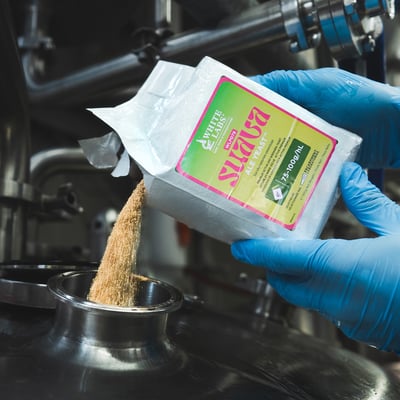
Kveik Strains are ready to spring into your summer brews!
Have you ever heard of a strain that can ferment hot and fast without adding phenolic characters to let your hops and malt shine?!
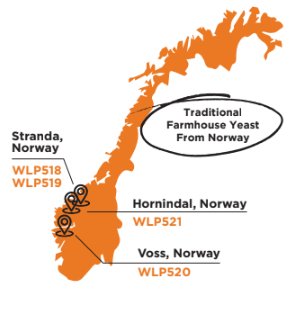 Don’t have temperature control for the hot summer months? Need to knock out a brew in less than 10 days?
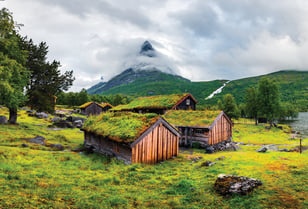
We have the strains for you! Kveik strains are traditional Norwegian farmhouse strains that brewers used from batch to batch using a kveik ring.
A traditional kveik ring is a yeast ring made of multiple wooden blocks strung together. These rings were tossed into hot brews and the yeast from the top of fermentations were able to dry on the wood. These dried yeast rings went from brew to brew, almost like the passing down and sharing of friendship bread.
These strains were sourced from our friend Lars Marius Garshol and each strain was isolated from a unique Norwegian brewer!
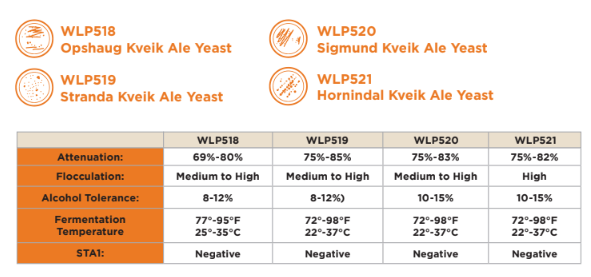
| Strain: |
|
|
|
|
| Strain Story: |
WLP518 Opshaug Kveik Ale Yeast was isolated and shared by Harald Opshaug, a farmhouse brewer in Stranda, Norway |
WLP519 Stranda Kveik Ale Yeast was shared by Stein Langlo from Stranda, Norway. |
WLP520 Sigmund Kveik Ale Yeast was shared by Sigmund Gjernes from Voss, Norway. Also known as Voss Kveik |
WLP521 Hornindal Kveik Ale yeast was shared with the world by Terje Raftevold from Hornindal, Norway. |
| Tasting Notes: |
Orange, Pineapple, Peach, Dried Fruit |
Stone fruit, Ripe Melon, Apricot |
Honey, Stone Fruit, Fusel Alcohol |
Apricot, Tangerine, |
*Sensory data pulled from brews from White Labs Brewing Co in a Hazy IPA fermented at 32°C
What makes them unique
- Through evolution, these strains can ferment at hotter while still letting the flavors of the beer shine through. Making them perfect for most styles!
- By fermenting hot and fast, the turnaround on fermentations can be quick and efficient!
The Kveik Experiment
Traditionally, brewing with Kveik strains is done in very different conditions from the conventional brewing practices, especially the considerably lower pitch rate (< 0.25 million cells/mL/°P) and much warmer fermentation temperatures (> 32°C).
In order to assess how these very special yeast strains behave in both traditional and modern brewing conditions, White Labs R&D department tested all White Labs Kveik strains in different combinations of fermentation temperature (20 and 32°C) and pitch rate (0.25 and 0.75 million cells/mL/°P). All the fermentations were monitored for pH and gravity, and the final beers were analyzed for ethanol production, aroma compounds, and sensory profile.
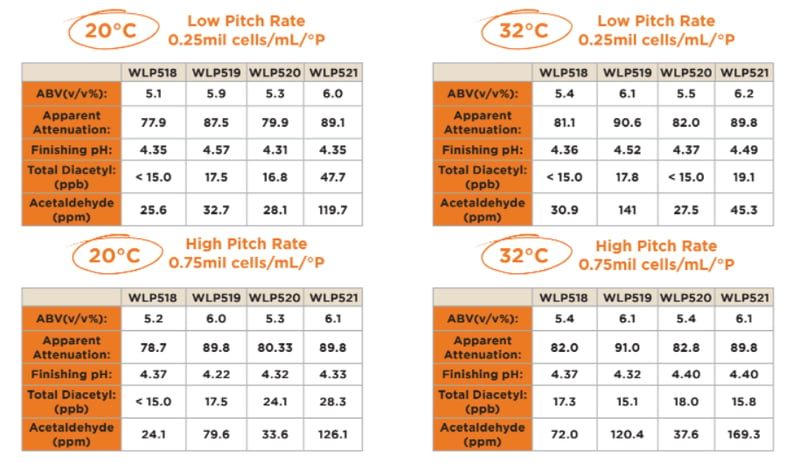
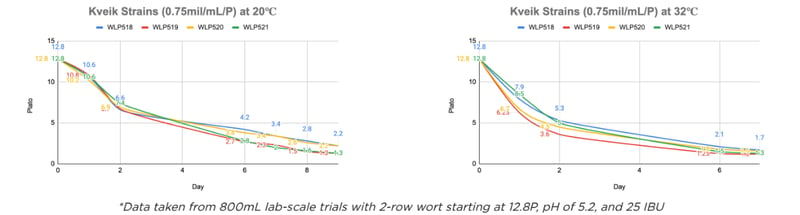 *As these trials were lab-scale, proper conditioning times were not performed but check out White Labs Brewing Co to see how these strains behave in actual 5BBL brews!
Conclusion
- We found most of our Kveik strains prefer being pitched at a lower pitching rate producing a cleaner profile, while higher pitch rates had more metabolite production.
- We also found higher alcohol by volume and apparent attenuation rate at fermentations at 32℃/90℉ rather than 20℃/68℉.
- Even with higher off-flavor levels, our sensory panel preferred the 32℃/90℉ ferments over the 20℃/68℉ ferments due to it being a more balanced beer.
Kveik Offerings