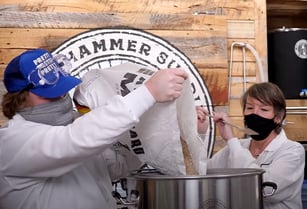
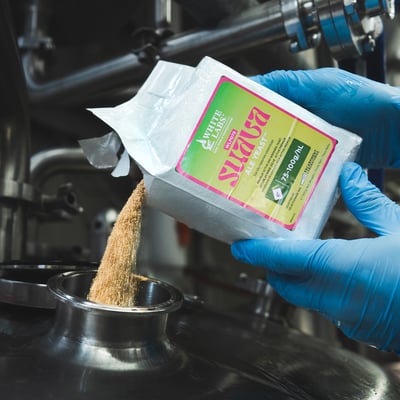
We enjoy surrounding ourselves with beer nerds of all caliber. For this yeast experiment, we found ourselves partnering with Clawhammer Supply to explore split batching homebrew and pitching four different yeast strains.
Splitting up a base wort with different yeast strains we looked at how each strain could turn the same wort into completely different beers. Yeast is like us, they have their individual preferences and behaviors.
For this brew day, Jo Doyle, our Education and Engagement Curator visited the Clawhammer Supply studio and brewed a 10-gallon split batch beer with Emmet Leahy, Clawhammer Supply’s Strategic Strategizer. One base wort (same water, grain, and hop) separated into four fermenters with four different yeast strains.
The Yeast:
We pitched and fermented at ambient room temperature between 70-72°F.
WLP001 California Ale Yeast
Attenuation in this beer: 86.19%
A classic strain used in many great beers, this was used as a control. The beer with WLP001 California Ale Yeast was great and to style, but not as interesting in flavor as the other three, however, it had a really nice crisp mouthfeel.
WLP066 London Fog Ale Yeast
Attenuation in this beer: 83.56%
A strain often used in “hazy” beers, it did well in this SMASH beer by promoting an ester profile to match the aromatics of the Zula hop.
WLP518 Opshaug Kveik Ale Yeast
Attenuation in this beer: 82.71%
Usually fermented at warm temperatures (30°C/85°F+), this strain produced mild fruit-like esters and fermented well (just not as quickly) at ambient temperatures.
WLP644 Saccharomyces brux-like Trois
Attenuation in this beer: 82.23%
Tropical fruit aromatics from yeast? You bet! This was the most unique of the lot and created an interesting drinkable beer.
The Recipe:
Malt:
Maris Otter - 23lbs (10.4kg)
Mash at 157°F (69.4°C)
Hops:
60 min addition - Zula 4oz (113.40 g)
Whirlpool addition - Zula 4oz (113.40 g)
The Data:
In addition to performing sensory on the beers, we sent samples to the White Labs Analytical Laboratory to look at the finished numbers. While taste is the most important instrument in determining beer quality, the numbers from the lab gleaned information about other factors that influence the beers flavor and mouthfeel.
Find the analytical data below:
SMASH Ale with WLP001 California Ale Yeast
SMASH Ale with WLP066 London Fog Ale Yeast
SMASH Ale with WLP518 Opshaug Kveik Ale Yeast
SMASH Ale with WLP644 Saccharomyces brux-like Trois
What We Learned:
Attenuations varied in each sample. Ranging from 86.2% in the WLP001 sample to 82.2% in the WLP644 sample. These differences in attenuation is a result of each strain's ability to metabolize sugar in the malt leading to differences in alcohol by volume (ABV).
Acetaldehyde was high in all the samples, although it didn’t jump out during sensory. This could be due to slightly warmer than preferred fermentation temperature and additional maturation time may have helped. The WLP066 sample had the highest at 142.89 ppm and the WLP644 sample had the lowest at 52.43 ppm. The flavor threshold of acetaldehyde in beer is 5 -15 ppm.
We found the diacetyl results were very low however, for instance, the highest amount which was 25.10 ppb was found in the WLP066. The flavor threshold of diacetyl in beer is 50 – 100 ppb.
Strain choice impacts the finished beer. Not only did strain choice change everything listed above it changed the overall drinking experience. Both Jo and Emmet enjoyed all four versions of the beer, yet each had its standouts. While Emmet voted for the beer fermented with WLP066 London Fog Ale Yeast for its juicy quality and a bit more dryness, Jo’s favorite was the one with WLP644 Saccharomyces brux-like Trois with its tart cherry and soft tropical notes.
The Last Call:
We would like to thank Clawhammer Supply again for opening up their studio and minds to look at yeast impact on beer through this fun experiment! We hope to continue this collaboration and follow the rabbit-hole of our never-ending quest for fermentation exploration.