Temperature is one of the three key cold-side variables, along with pitch rate and dissolved oxygen, that brewers can control to influence fermentation performance and flavor. We’ll break down how temperature impacts yeast activity from knockout through the end of fermentation, and how dialing it in leads to consistent, predictable results.
Knockout
- Take your yeast out of the cooler a few hours before pitching. If the yeast doesn’t warm to room temperature there is a risk of shocking it. Additionally, it may be more difficult to homogenize the yeast before pitching.
- Be sure to check the temperature of the wort at knockout before pitching the yeast. Large swings in temperature, in either direction, can cause performance and flavor issues to arise. Drastically lowering the fermentation temperature may slow down the expected fermentation timeline or risk the yeast culture going dormant. And because temperature shock can reduce initial cell activity, using the Pitch Rate Calculator helps ensure you're starting with the right number of healthy, active cells for your target fermentation temperature range.
- Knockout temperature is important to consider because it affects how the yeast will propagate (grow and divide) in the initial 48-72 hours. Warmer temperatures increase cell activity and allow yeast to divide quicker. This is why ale pitching rates tend to be lower than lagers. Ales are commonly fermented at warmer temperatures allowing the yeast culture to grow more rapidly and to a larger population size. The cooler temperatures at knockout for lager yeast requires a larger pitch due to the suppressed growth and activity.
Fermentation
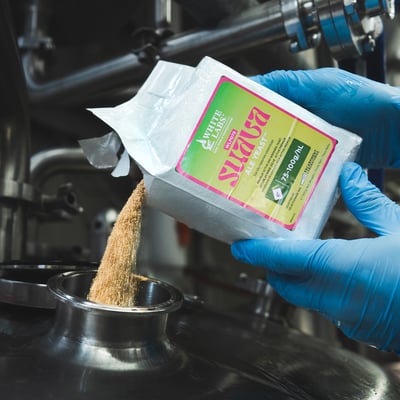
Each yeast strain has an ideal temperature range where it balances fermentation performance and flavor production. These guidelines influence attenuation, flocculation, ester expression, and overall fermentation speed. PurePitch Next Generation pouches make it easy to check these parameters; just scan the QR code for strain-specific details.



There are strategies to altering the temperature throughout fermentation. Increasing temperature toward the final days when the gravity is approaching terminal can help the remaining active yeast clean-up undesirable off-flavors and aromas. Contrarily, some lager fermentation profiles pitch yeast at knockout a bit warmer to support cell division and growth, then lower the temperature shortly after to limit flavor metabolite production throughout the rest of fermentation.
No matter the strategy used, if you want more predictable fermentations click the link below to learn how PurePitch technology brings consistency on the cold-side.
Warmer Temperatures
Pro
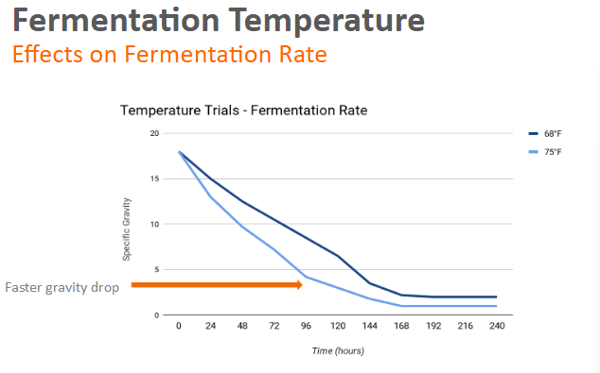
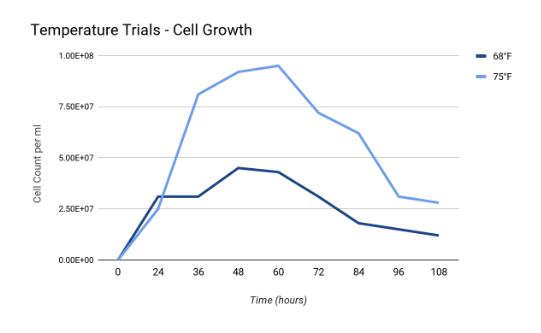
- Warmer temperatures can mean a quicker fermentation timeline. At warmer temperatures, yeast are more active which leads to quicker budding and fermentation. As seen in the graphs below comparing fermentation at 68℉ vs 75℉.
- A diacetyl rest is common in the brewing process, this practice of raising the temperature near the end of fermentation helps the yeast get more active to reabsorb diacetyl, the unwanted butter popcorn off-flavor.
- A good practice for Imperial beers is increasing your temperature in steps throughout fermentation. As the yeast needs to eat through a larger portion of sugar, an increase in temperature may give the culture the extra boost needed to complete fermentation.
Con
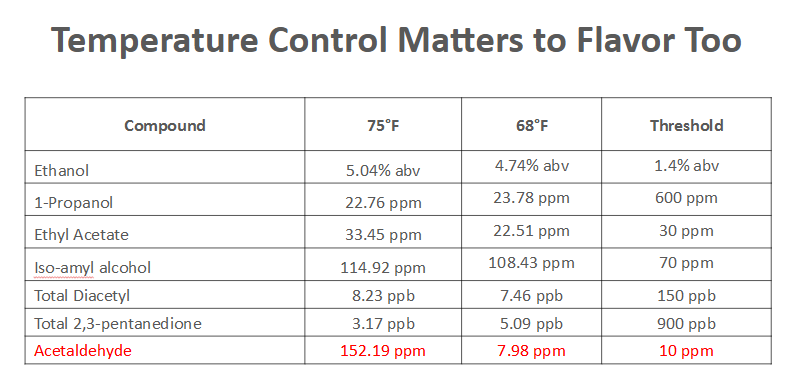
- Warmer temperatures lead to more cell growth, which tends to lead to more flavor production. Esters, fusel alcohols, and other metabolites are formed when yeast grows as part of the nature metabolic process. This may be ideal for styles like saisons or Belgians, but it can also lead to unwanted flavor expression in styles with more delicate flavor profiles.
- Too much of a good thing can occur with flavor and aroma. A compound like ethyl acetate may be fruity and pleasing at levels just above sensory threshold, but if production increases to high this metabolite can be perceived as nail polish remover.
Cooler Temperatures
Pro
- To understand the beneficial affects of cooler fermentations in beer, think of styles like traditional European lagers or the new-age cold IPA. Colder temperatures will help highlight other ingredients such as the malt and hops.
- Some of our favorite lagers are done the traditional way of holding 8-10°C throughout fermentation.
- Genes related to flocculation can be more expressed at colder temperatures. We recommend a step crash to allow for these genes to create lectin-like proteins that aid in flocculation.
Con
- Due to the reduction in yeast cell activity at colder temperatures, fermentation timelines can be greatly extended. Longer production timelines reduces tank space in a brewery for production of other productions.
- Less yeast growth in the initial lag phase of fermentation means brewers have to pitch more yeast to hit their target cell populations. Larger yeast pitches bring a higher cost. Combine this with longer tank residency and beers fermented cooler can become costly.
Alter Strain or Temperature?
This section provides context to the question, "If I am aiming for a particular amount of an aroma or flavor, should I adjust the fermentation temperature with my current strain or source a different strain altogether?"
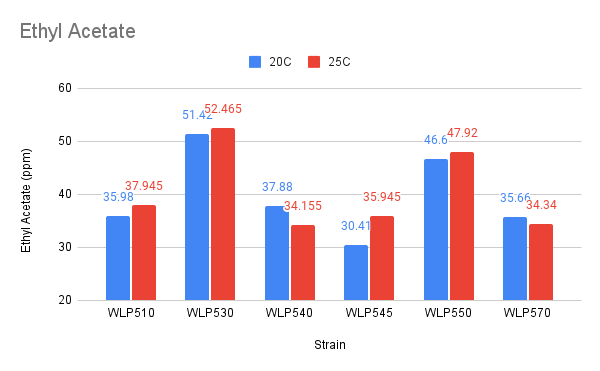
To help conceptualize the question, let's look at a small study we conducted on two groups of strains, Belgian Abbey and Saison, using lab fermentations at different temperatures. The data suggests that not all strains behave the same under the warmer and cooler temperature conditions as described above. In the bar graphs below you can see that a few of the strains actually produced less, or relatively the same, quantities of ethyl acetate at higher temperatures.
BELGIAN abbey
saison
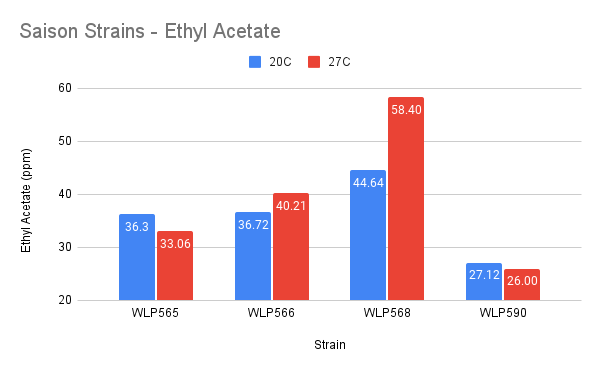
This demonstrates that each strain is unique and requires trials to perfectly dial in the flavor profile for a given beer. Warmer and cooler temperatures generally have the effects described previously, but this may not be the case for every strain. Selecting a different strain may be the answer in some cases when the current strain doesn't fluctuate much with temperature. Though for other strains, we observe large differences that may lead to the desired aroma attributes. Further studies on these groups, along with other groups of strains from historical regions, would help provide additional evidence of the effects of temperature changes.
Conclusion
Ultimately, the easiest way to greatly alter the flavor profile is by changing the yeast strain. Though, when fine-tuning and making small changes, temperature control can be a powerful tool in a brewer's toolkit. We can alter our fermentations to fit our production timelines or optimize certain flavor profiles to create complexity. Whether you're developing a new recipe or troubleshooting a fermentation issue, the balance of temperature, pitch rate, and dissolved oxygen are the three key aspects to consider when thinking about your yeast culture.
Happy Brewing!